Granite Laser Engraving Machines: How They Work and What to Consider
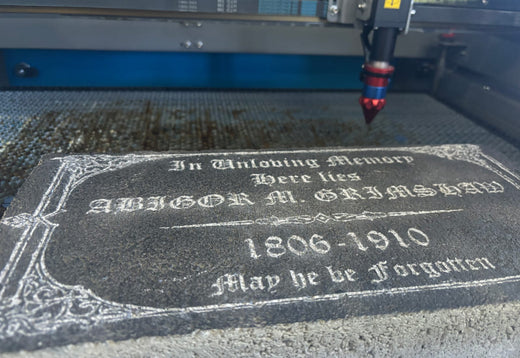
A granite laser engraving machine uses a focused laser beam to create text, images, patterns, and other designs on granite surfaces. From memorial plaques and address stones to signs and decorative pieces, laser engraving offers a precise way to personalize this durable natural material.
How Laser Engraving Works on Granite
Unlike a rotary engraver, which cuts into a surface with a physical tool, a laser directs concentrated energy at selected points on the stone. The heat changes or removes tiny areas of the surface, creating a visible design. On many polished granite surfaces, the engraved areas appear lighter than the surrounding stone, producing strong contrast.
CO2 laser systems are commonly used for engraving stone. The best machine and settings depend on the granite, the finish, the design, and the result you want. Granite varies in color, mineral composition, texture, and hardness, so a setting that works well on one slab may not produce the same result on another. Test pieces are essential.
Common Uses
- Memorials: Add names, dates, inscriptions, and portraits to headstones and memorial plaques.
- Signs: Create business signs, wayfinding markers, property signs, and building plaques.
- Home and garden décor: Personalize tiles, coasters, stepping stones, and decorative pieces.
- Custom gifts: Engrave photographs, messages, logos, or artwork onto granite items.
- Commercial products: Produce repeatable designs for awards, branded merchandise, and architectural details.
Choosing a Granite Laser Engraving Machine
Before selecting a machine, consider the size and weight of the granite pieces you plan to process, the level of detail required, and how often the equipment will be used. Granite is heavy, so a suitable work area and a stable machine bed are important. Also check whether the machine’s working area can accommodate your largest projects.
Key features to compare
- Laser type and power: Choose a configuration intended for your materials and production needs. Higher power does not automatically mean better detail or a better finish.
- Work area and bed design: Confirm that the machine can safely support the dimensions and weight of your workpieces.
- Motion and focus control: Reliable motion components and consistent focusing help produce clear, repeatable designs.
- Software compatibility: Check support for your design workflow, common file formats, and image-processing features.
- Extraction and filtration: Engraving can generate dust, particulates, and fumes. The machine should be used with suitable ventilation and filtration.
- Service and training: Ask about installation, operator training, replacement parts, and technical support.
Preparing Granite for Engraving
Start with a clean, dry surface. Dust, residue, moisture, or protective coatings can affect the result. Prepare the design at an appropriate resolution and size, then position the granite securely. Because natural stone can vary even within a single slab, run a small test using similar material before engraving the final piece.
For photographic engraving, image preparation is especially important. Contrast, brightness, and dithering or halftone settings can influence how the image translates to stone. A test sample helps identify the settings that best preserve detail and produce the desired contrast.
Safety and Maintenance
Laser engraving equipment should be operated according to the manufacturer’s instructions. Use the machine’s required laser enclosure and protective features, and never look directly at an active laser beam. Keep the work area clear of combustible materials and do not leave the machine running unattended.
Stone processing can produce airborne particles. Granite may contain crystalline silica, so use appropriate source-capture ventilation and filtration, follow the equipment and material safety guidance, and comply with applicable workplace safety requirements. Do not rely on an ordinary room fan to control exposure.
Regularly inspect and clean the machine as directed by its manufacturer. Keeping optics, rails, and the work area clean can support consistent performance. Use only cleaning methods approved for the specific equipment.
Is a Laser Engraver Right for Your Granite Projects?
A granite laser engraving machine can be a useful choice for businesses and makers who need detailed, customizable designs on stone. Its strengths include contact-free processing, flexibility for artwork and text, and the ability to repeat designs with consistent positioning. Results depend on machine capability, material variation, design preparation, and operator testing.
Before investing, review sample engravings on granite similar to the material you plan to use. Compare the clarity, contrast, processing time, and operating costs, and confirm that the machine includes appropriate safety and extraction provisions. Careful selection and testing can help you produce attractive, durable granite engravings.
7 Key Benefits of a Granite Laser Engraving Machine
- Creates precise, detailed designs
- Engraves text, logos, and photos
- Works without physical cutting tools
- Supports custom, one-of-a-kind products
- Delivers consistent repeatable results
- Handles a range of granite projects
- Suitable for signs, plaques, and décor
4 Drawbacks of Granite Laser Engraving Machines
- High upfront equipment cost
- Requires effective dust extraction
- Granite variations can affect results
- Large stones are difficult to handle
Creates precise, detailed designs
A granite laser engraving machine can create precise, detailed designs by directing a focused beam onto specific points on the stone. This accuracy makes it possible to reproduce fine lettering, intricate patterns, logos, and carefully prepared images with crisp, consistent results. Because the laser works without a cutting tool touching the granite, it can also help maintain clean design edges across a range of customized projects.
Engraves text, logos, and photos
A granite laser engraving machine can reproduce a wide range of designs, from crisp text and company logos to detailed photographs. This versatility makes it useful for creating personalized memorials, custom signs, awards, and decorative pieces. With the right image preparation and machine settings, designs can be engraved with clear detail and lasting contrast on granite.
Works without physical cutting tools
A granite laser engraving machine works without physical cutting tools, so the design is created by a focused beam rather than a bit or blade pressing against the stone. This contact-free process helps reduce tool wear and mechanical stress on the workpiece, while making it easier to engrave fine details, text, and intricate patterns. It can also simplify production by avoiding frequent tool changes, though results still depend on the granite and the machine settings.
Supports custom, one-of-a-kind products
A granite laser engraving machine makes it easy to create custom, one-of-a-kind products tailored to each customer. From names, dates, and personal messages to logos, intricate artwork, and photo-inspired designs, each engraving can be made unique. This flexibility helps businesses offer meaningful memorials, personalized gifts, custom signs, and decorative pieces that stand out from mass-produced products.
Delivers consistent repeatable results
A granite laser engraving machine delivers consistent, repeatable results by following the same digital design and programmed settings for each job. This makes it easier to reproduce lettering, logos, and artwork with uniform placement and detail across multiple pieces. Once the settings are tested for a particular type and finish of granite, they can serve as a reliable starting point for future projects, helping reduce variation and save preparation time.
Handles a range of granite projects
A granite laser engraving machine can handle a wide variety of projects, from small personalized keepsakes and decorative tiles to signs, plaques, and memorials. With a suitable work area and the right settings, it can engrave text, logos, patterns, and detailed images on different granite pieces. This versatility makes it a practical option for businesses and makers serving customers with varied design needs.
Suitable for signs, plaques, and décor
A granite laser engraving machine is a versatile choice for creating signs, plaques, and decorative pieces. It can engrave names, logos, messages, patterns, and artwork onto granite for applications ranging from business and property signage to commemorative plaques and personalized home décor. Because designs can be customized for different sizes and styles, one machine can support a wide variety of projects.
High upfront equipment cost
A granite laser engraving machine can require a significant upfront investment, especially when you factor in the laser system, ventilation and filtration equipment, software, installation, and operator training. This initial cost may be challenging for small businesses or occasional users, and it can take time for the machine to pay for itself. Before purchasing, compare the full setup costs with expected project volume, pricing, and ongoing maintenance needs.
Requires effective dust extraction
Granite laser engraving requires effective dust extraction because the process can release fine particles that may pose health risks and settle on the machine’s optics and moving parts. A suitable extraction and filtration system helps capture dust at the source, protect operators, keep the work area cleaner, and support reliable machine performance. Follow the equipment manufacturer’s guidance and applicable workplace safety requirements when selecting and maintaining the system.
Granite variations can affect results
Granite varies in color, mineral composition, texture, and hardness, so a laser engraving machine may produce different results from one piece to another. The same settings can create a crisp, high-contrast design on one slab but a lighter or less consistent engraving on another. To get predictable results, operators may need to test each type of granite and adjust the laser settings, which can add time and material costs.
Large stones are difficult to handle
Large stones can be difficult to handle when using a granite laser engraving machine. Their weight and size may make loading, positioning, and securing them on the machine bed challenging, often requiring extra space, lifting equipment, or help from another person. This can slow down production and increase the risk of damaging the stone or straining the operator if proper handling procedures are not followed.
No Responses