Fiber-Coupled LED: How It Works and Where It’s Used
A fiber-coupled LED combines a light-emitting diode with an optical fiber to deliver light to a specific location. The LED generates the light, while lenses and other optical components direct it into the fiber. The fiber then carries the light to an instrument, work area, or sample.
This arrangement is useful when a light source needs to be positioned away from the point of use, or when illumination must be delivered through a narrow, flexible path. Fiber-coupled LEDs are found in laboratory equipment, industrial inspection systems, medical devices, and many other applications.
How a Fiber-Coupled LED Works
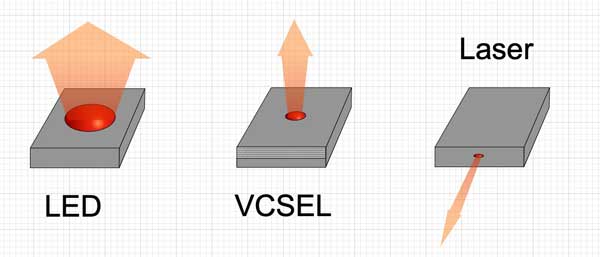
An LED emits light over a relatively broad area and across a range of angles. An optical system—often made up of one or more lenses—collects some of that light and focuses it into the fiber’s input. The fiber guides the light to its output end, where it illuminates a target or feeds another optical component.
Many systems use multimode fibers, which can carry light along multiple paths. The amount of light that enters the fiber depends on several factors, including the LED’s emitting area, the lens design, the fiber’s core diameter, and its numerical aperture. Numerical aperture describes the range of angles at which light can enter or leave the fiber.
Common Applications
- Microscopy: Fiber-delivered illumination can provide light to samples in compact or specialized microscope setups.
- Machine vision: LEDs can supply consistent illumination for cameras inspecting parts, surfaces, or labels on a production line.
- Spectroscopy: Selected LED wavelengths can be directed to a sample for measurement or analysis.
- Medical and dental equipment: Flexible fibers can deliver illumination to areas that are difficult to reach with a conventional lamp.
- Industrial sensing: Fiber delivery can help place light sources in confined spaces or keep electronics away from heat, vibration, or contamination.
- Research and testing: A fiber-coupled source can provide controlled illumination for experiments and optical instruments.
Benefits
One key benefit is flexibility in system layout. The LED and its driver can be mounted in a convenient location, while the fiber carries light to the point of use. This can make it easier to reach confined spaces and can reduce the need to place electrical components near a sample or work area.
LEDs are also available in many colors and wavelength ranges, and they can be switched or modulated electronically. Depending on the model and system design, they may offer long operating life, relatively low power consumption, and stable output. A fiber can also help create a compact, neatly routed illumination system.
Limitations and Design Considerations
Not all light from an LED enters the fiber. Coupling efficiency—the fraction of emitted light successfully transferred into the fiber—depends on how well the LED, optics, and fiber are matched. A small fiber core or a low numerical aperture may limit the amount of light collected.
Other factors to consider include the required wavelength, output power, uniformity, and beam shape. Fibers also have minimum bend radii; bending one too tightly can reduce output or damage it. For high-output systems, heat management is important because LED performance and lifetime can be affected by operating temperature.
How to Choose a Fiber-Coupled LED
Start with the application’s illumination requirements. Identify the wavelength or color needed, the desired output at the fiber tip, and whether continuous or pulsed operation is required. Then check that the fiber’s core size and numerical aperture are compatible with the LED and coupling optics.
It is also helpful to consider the operating environment, fiber length, connector type, and available mounting space. If color stability, timing, or repeatability matters, review the source’s control options and output specifications. Testing the complete assembly under real operating conditions can confirm that the light delivered at the fiber tip meets the application’s needs.
Conclusion
A fiber-coupled LED offers a practical way to deliver controlled illumination through a flexible optical path. Its performance depends on matching the LED, coupling optics, and fiber to the task. With the right configuration, it can provide compact and adaptable lighting for scientific, medical, and industrial systems.
Fiber-Coupled LED FAQs: LED Types, Fiber Optic Lighting, Laser Diodes, and Eye Safety
- What are the three types of LEDs?
- What are fiber optic LED lights?
- What is a fiber-coupled laser diode?
- Which type of LED is best for eyes?
What are the three types of LEDs?
The three main types of LEDs are indicator LEDs, which provide simple status or signal lighting; high-intensity LEDs, which produce brighter light for applications such as task and general illumination; and specialty LEDs, designed for specific purposes, such as infrared, ultraviolet, or color-specific output. In fiber-coupled systems, the best type depends on the required wavelength, brightness, and application.
What are fiber optic LED lights?
Fiber optic LED lights use an LED as the light source and optical fibers to carry its light to one or more locations. The LED may sit in a separate housing, while the thin, flexible fibers deliver illumination to hard-to-reach areas or create decorative lighting effects. Unlike systems that generate light along the fiber, the fibers in these setups guide light from the LED to their ends.
What is a fiber-coupled laser diode?
A fiber-coupled laser diode is a laser diode whose light is focused into an optical fiber and delivered through the fiber to a target or optical system. Unlike an LED, it produces a narrow, highly directional beam, which can provide concentrated light for applications such as sensing, communications, medical devices, and industrial processing. Its performance depends on factors such as wavelength, output power, fiber type, and coupling efficiency.
Which type of LED is best for eyes?
The best LED for eye comfort is typically one that provides the right brightness for the task, has low flicker, and avoids harsh glare; no single LED type is best for everyone. For a fiber-coupled LED, choose a source with suitable color temperature and output, and use diffusers or indirect lighting when possible. Never look directly into a high-intensity LED or the fiber output, as concentrated light can harm the eyes. Follow the manufacturer’s safety guidance, especially for high-power or blue-light sources.
No Responses